 RTO Vehicle Information
How to Check Vehicle Owner Details by Number Plate Online in India
Whether you are buying a used car or motorcycle, verifying legal ownership after a road mishap, or checking insurance and fitness validity, the Government of India provides digital access to Registration Certificate (RC) records through the centralized VAHAN national database. Learn how to look up authentic vehicle details legally, securely, and within minutes.
Explore Your Vehicle Services
What Are Vehicle Owner Details?
Legal framework, definition, and data maintained under Section 41 of the Motor Vehicles Act, 1988.
Under Indian transport law, Vehicle Owner Details refer to the comprehensive statutory records documented on a motor vehicle's Registration Certificate (RC). When a motor vehicle (car, scooter, truck, tractor, or commercial carrier) is registered with a Regional Transport Office (RTO) or Registering & Licensing Authority (RLA), all key parameters are recorded in the central VAHAN National Registry managed by the Ministry of Road Transport and Highways (MoRTH).
Legal Ownership
Verifies who legally holds title to the vehicle, registering RTO jurisdiction, vehicle serial number, and transfer history.
Statutory Compliance
Confirms whether third-party insurance, fitness certificate (FC), pollution under control (PUC), and road taxes are currently active.
Financial & Crime Liens
Identifies active bank hypothecation (loans), pending traffic challans, and blacklisting or theft reports filed with the police.
How to Check RTO Vehicle Information on Official Portals
Authorized government methods to search vehicle registration details online via web and mobile.
1Method 1: Official VAHAN Parivahan Portal (Desktop & Mobile Web)
Open VAHAN Portal ↗The Ministry of Road Transport and Highways manages the VAHAN Citizen Services portal for real-time RC verification across India. Follow these verified steps to retrieve complete vehicle information:
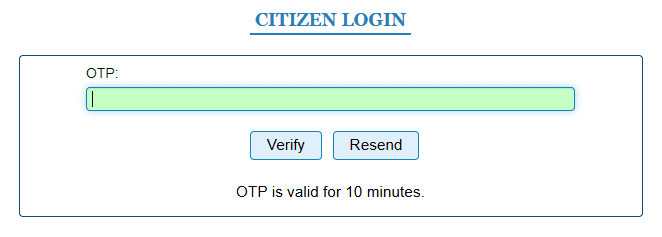
Step 3: Secure Mobile OTP Verification Screen on Parivahan
DL01AB1234, NOT DL 01 AB 1234). Complete the security captcha code shown on your screen.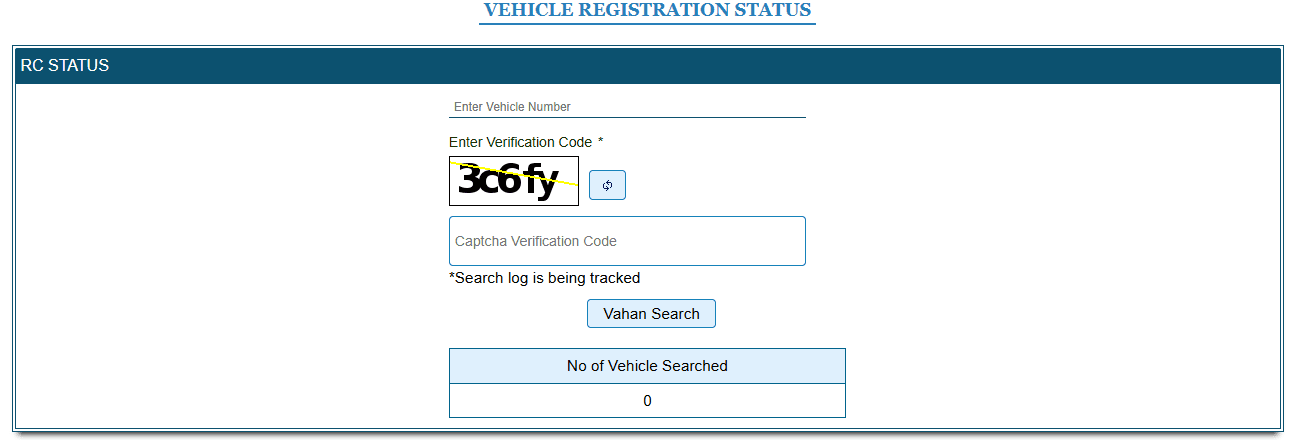
Step 4: Entering Registration Number Plate and Security Captcha
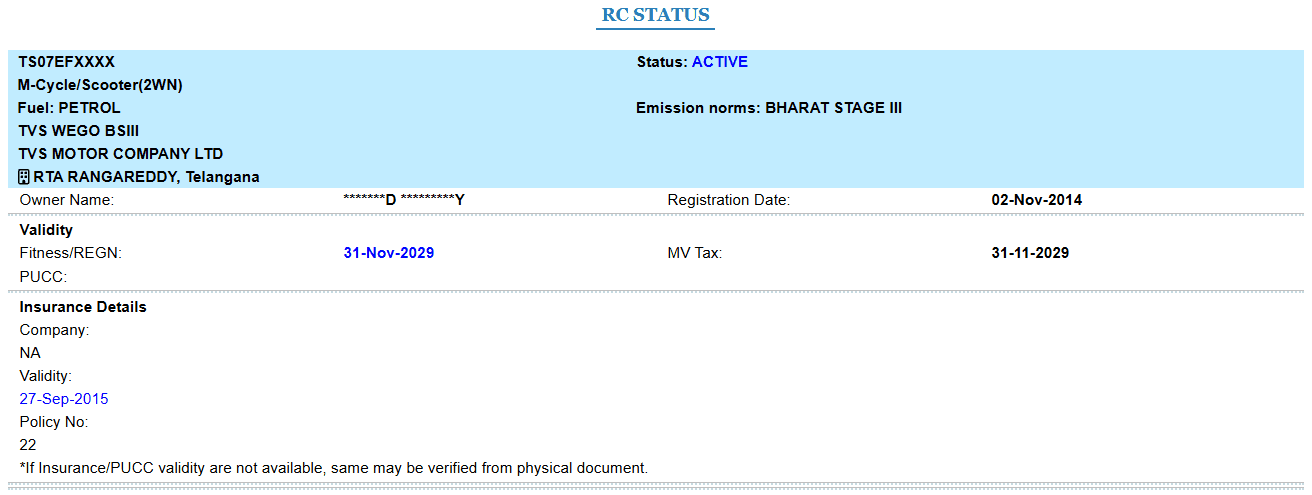
Step 5: Generated Vehicle Details with Insurance, Fitness, and Tax Records
Method 2: NextGen mParivahan App
The official smartphone application developed by NIC allows citizens to create a Virtual RC on their mobile device that is legally recognized across India.
- 1.Download NextGen mParivahan from Google Play Store or Apple App Store.
- 2.Register using your mobile number and set an MPIN.
- 3.Under the "Vehicle Search" bar, enter the vehicle registration number.
- 4.View RC status, or enter Chassis/Engine digits to add it to your dashboard as a Virtual RC.
Method 3: SMS Service (Offline Feature Phones)
For rural areas or locations with poor mobile internet, MoRTH operates an automated nationwide SMS query gateway:
VAHAN <Registration Number>Send SMS to: 7738299899Example: Send VAHAN DL01AB1234 to 7738299899. Standard operator SMS tariffs apply. Note that availability may vary depending on cellular operator gateways.
MH-02-CB-1234 as MH02CB1234. Entering spaces frequently returns a "No Record Found" error.What Vehicle Owner Details Are Available Online?
Understanding public data transparency vs. citizen privacy protection under MoRTH rules.
To balance transparency with citizen privacy and security, the Ministry of Road Transport and Highways (MoRTH) implemented privacy masking rules. While vehicle specifications, safety compliance, and legal liens are unmasked and fully visible, personally identifiable information (PII) is partially masked to protect citizens from identity theft and harassment.
| RC Parameter | What It Represents | Status on Public Portal |
|---|---|---|
| Vehicle Registration Number | The unique state-issued alpha-numeric identification number plate. | ✓ Unmasked (Visible) |
| Registered Owner Name | Legal title holder. Displayed partially obscured (e.g. R***H K***R) for privacy protection. | 🔒 Masked (Privacy) |
| Chassis Number (VIN) | 17-digit Vehicle Identification Number stamped on vehicle frame. Last 5 digits masked. | 🔒 Masked (Partial) |
| Engine Number | Unique serial number stamped onto engine block. Last 5 characters masked to prevent cloning. | 🔒 Masked (Partial) |
| Registration Date | Exact date the motor vehicle was officially registered with the RTO. | ✓ Unmasked (Visible) |
| Vehicle Class & Category | Official classification such as LMV (Car/Jeep), Two Wheeler, HMV, Maxi Cab, or Goods. | ✓ Unmasked (Visible) |
| Fuel Type & Emission Standard | Power source (Petrol, Diesel, CNG, LPG, Pure Electric, Hybrid) and emission standard (BS-IV, BS-VI). | ✓ Unmasked (Visible) |
| Maker & Model Variant | Manufacturer name, vehicle brand, and specific commercial trim/variant. | ✓ Unmasked (Visible) |
| Registering Authority (RTO) | The specific regional transport office or SDM branch where the vehicle is documented. | ✓ Unmasked (Visible) |
| RC & Fitness Validity (FC) | Expiration date of registration (15 years for private cars) or commercial fitness certificate. | ✓ Unmasked (Visible) |
| Insurance Policy Validity | Insurance company name, policy number, and expiry date (crucial for accident claims). | ✓ Unmasked (Visible) |
| PUC (Pollution) Expiry | Date through which the Pollution Under Control certificate remains legally certified. | ✓ Unmasked (Visible) |
| Hypothecation (Bank Lien) | Indicates if the vehicle is financed by a bank/lender (e.g. HDFC, SBI, ICICI) or loan-free. | ✓ Unmasked (Visible) |
| MV Road Tax Status | Shows whether lifetime tax (One Time Tax - OTT) is cleared or periodic commercial tax is due. | ✓ Unmasked (Visible) |
Why You Must Check Vehicle Owner Details
Essential scenarios where checking vehicle registration records prevents financial loss, legal penalties, and fraud.
🚗 Buying a Second-Hand Car or Bike
Used vehicle scams are widespread. Checking the RC on VAHAN reveals if the seller is truly the registered owner, whether the vehicle has an active bank hypothecation, if it was reported stolen, or if it is an expired 10/15-year-old vehicle prohibited in regions like Delhi-NCR.
💥 Road Accidents & Hit-and-Run Incidents
If you are involved in a traffic accident, noting down the other vehicle's number plate allows you to check their insurance policy number and issuing insurer. This information is required by police when filing an FIR and by courts when claiming compensation under Motor Accident Claims Tribunals (MACT).
👮 Routine Police & Traffic Inspection
If you misplace or forget your physical RC card, showing your verified digital Virtual RC on the mParivahan or DigiLocker app satisfies Section 139 of the Central Motor Vehicles Rules. Traffic police cannot fine you for failing to carry physical hard copies if valid digital records are presented.
📝 After Selling Your Vehicle
When you sell your vehicle, the buyer must execute an ownership transfer at the RTO via Form 29 and Form 30 within 30 days. Checking the number plate periodically confirms whether the title has transferred out of your name, protecting you from liability for subsequent accidents or traffic challans.
How to Verify a Used Vehicle Before Buying: 7-Point Safety Checklist
Follow this comprehensive checklist to ensure a second-hand vehicle is completely legal, free of bank debts, and accident-free.
Match Stamped Chassis & Engine Numbers with the RC
Physically inspect the VIN/Chassis number stamped on the vehicle's metal frame (often under the windshield, driver's seat, or engine bay) and the engine number stamped on the block. Ensure all digits match the Registration Certificate and VAHAN portal records exactly.
Verify the Seller's Government Identity Matches Owner Records
Avoid transacting with third-party agents or unverified intermediaries claiming Power of Attorney. Request the seller's original Aadhaar and PAN card, and verify that their name aligns with the masked owner initials shown on Parivahan.
Check Bank Hypothecation & Demand Form 35 with Bank NOC
If the VAHAN portal lists a financial institution under Hypothecation, the vehicle has an outstanding loan. Never hand over payment until the seller provides an official Bank NOC (No Objection Certificate) and two signed copies of Form 35 to remove the bank's lien at the RTO.
Inspect Active Fitness, Insurance & Green Tax Validity
Ensure the vehicle has at least 6 months of valid comprehensive insurance and that the 15-year RC fitness has not lapsed. Expired registration certificates incur heavy retroactive penalty fees and cannot be driven legally on public roads.
Check for Unpaid Traffic e-Challans
Visit the official e-Challan portal (echallan.parivahan.gov.in) and enter the vehicle registration number. Ensure that the seller clears all pending speeding, red-light, or parking fines prior to sale.
Confirm Blacklist & Crime Record Status on VAHAN
Ensure that the vehicle is not flagged on the National Crime Records Bureau (NCRB) database or tagged as Blacklisted by police or transport authorities due to tax defaults, bank seizure notices, or stolen vehicle alerts.
Inspect Insurance Claim History (Accidental Total-Loss Checks)
Request the vehicle's past insurance policy renewals and verify No Claim Bonus (NCB) records. A sudden reset of NCB often reveals that the vehicle underwent significant accidental body repair or flood damage repair during previous ownership.
Is It Legal to Check Vehicle Owner Details Online?
Yes, accessing vehicle registration data through authorized portals such as VAHAN, Parivahan Sewa, and mParivahan is completely legal in India under the statutory framework of the Motor Vehicles Act, 1988, and the Central Motor Vehicles Rules, 1989.
However, using vehicle registration data for harassment, fraud, cyberstalking, or unauthorized commercial databases is strictly prohibited under the Digital Personal Data Protection (DPDP) Act, 2023 and the Information Technology Act, 2000. Government portals maintain encrypted access logs of all search queries associated with logged-in citizen mobile numbers.
Frequently Asked Questions
Common queries regarding vehicle registration verification, masked owner names, and RTO rules.
Q: What details can I check using a vehicle registration number online?
A: Through the official Parivahan and VAHAN portals, you can verify the vehicle's registration date, registering RTO, vehicle class (LMV/HMV/2W), fuel type (Petrol/Diesel/CNG/EV), maker and model, RC validity, fitness certificate expiry, insurance policy number and validity, PUC expiry, and bank hypothecation (loan) status.
Q: Can I see the full unmasked name and home address of a vehicle owner online?
A: No. Under the Ministry of Road Transport and Highways (MoRTH) privacy guidelines and the Digital Personal Data Protection (DPDP) Act, public search results mask personal owner names (e.g., displaying as 'R***H S***H') and completely conceal residential addresses and phone numbers to prevent stalking, theft, and harassment.
Q: How can I legally obtain the full unmasked owner details in an emergency or accident?
A: If you are involved in a road accident, hit-and-run, or legal dispute, law enforcement agencies (Police) and insurance claim investigators can access unmasked records through dedicated police portals. Citizens can also file a formal application with the local RTO or submit an FIR copy.
Q: Is the mParivahan mobile app free and officially recognized by traffic police?
A: Yes, mParivahan is an official mobile application developed by the National Informatics Centre (NIC) under MoRTH. Under Rule 139 of the Central Motor Vehicles Rules (CMVR), presenting a digital Virtual RC on mParivahan or DigiLocker is legally equivalent to carrying physical original documents across India.
Q: Can I check two-wheeler (bike/scooter) and commercial vehicle details as well?
A: Yes. The VAHAN database is unified nationwide. You can look up all categories of motor vehicles—including private two-wheelers, cars, commercial taxis, auto-rickshaws, buses, and heavy multi-axle freight carriers—registered across any Indian state or union territory.
Q: How do I check if a second-hand vehicle has pending traffic challans or is blacklisted?
A: You can verify pending fines directly on the official Parivahan e-Challan portal (echallan.parivahan.gov.in) by entering the vehicle registration number. To verify blacklisted or stolen status, check the VAHAN citizen portal or the National Crime Records Bureau (NCRB) vehicle database.
Q: What does 'Hypothecation' mean in vehicle registration records?
A: Hypothecation indicates that the vehicle is financed under an active bank loan or NBFC credit agreement. The financer maintains a financial lien on the vehicle. Before purchasing a used vehicle, ensure the seller provides an official Bank NOC and Form 35 to cancel the hypothecation.
Q: Why does the VAHAN portal require mobile OTP login to check vehicle details?
A: MoRTH introduced mandatory citizen login with mobile OTP verification to prevent unauthorized automated bot scraping, safeguard citizen privacy, and maintain a secure audit trail of search queries.
Published by Nagaraju
Senior Transport Policy Researcher & RTO Information Specialist at RTO Vehicle Info Hub.
Disclaimer
RTO Office Details is an informational portal designed to help users easily find RTO office information, vehicle registration details, driving licence status, and insurance-related information.
We are not an official government website. All data and links provided are for informational purposes only.
For any official verification please visit https://parivahan.gov.in/ or contact your respective State Transport Department.